
Pet Movement Legislation
Country of Departure
Pet Import from the UK to Russia
– Requirements & Documents
This page summarises the official veterinary requirements of the Russian Federation for importing dogs and cats from the United Kingdom for non-commercial purposes (personal pets, relocation, travel). When the rules below are met, no separate import permit or quarantine decision from Rosselkhoznadzor is required for up to two animals per owner.
General Import Requirements for Dogs and Cats
Microchip
A microchip is mandatory for all pets entering Russia. It must:
- Be implanted before the rabies vaccination.
- Comply with ISO 11784/11785 standards.
- Have its number recorded in the pet passport and/or veterinary certificate.
Mandatory Vaccinations for Dogs
Under Russian rules, each dog imported into the Russian Federation must be vaccinated against the following diseases:
- Rabies
- Canine distemper
- Infectious canine hepatitis (adenovirus)
- Parvoviral infection
- Adenoviral infections (CAV-2)
- Leptospirosis (if the dog has not been treated with dihydrostreptomycin or an equivalent licensed substance)
Validity of vaccinations for dogs:
- All non-rabies vaccines listed above must not be older than 12 months at the time of departure.
- If any of these vaccines were not given within the last 12 months, revaccination must take place no later than 20 days before departure.
Rabies vaccination for dogs:
- The rabies vaccine must be valid at the time of entry.
- Russia accepts rabies vaccines with a revaccination interval longer than one year if:
- The issuing veterinarian confirms in the certificate that the immunity period has not expired, or
- A laboratory test confirms rabies antibody levels of at least 0.5 IU/ml.
- Puppies under 3 months of age may be imported without rabies vaccination under Russian rules.
Mandatory Vaccinations for Cats
For cats, the following vaccinations are required:
- Rabies
- Panleukopenia (feline panleukopenia)
Validity of vaccinations for cats:
- Cats vaccinated against panleukopenia with a vaccine that has a revaccination interval longer than 12 months cannot be imported if 12 months or more have passed since vaccination.
- If the cat has not been vaccinated against panleukopenia within the last 12 months, the vaccine must be administered no later than 20 days before departure.
Rabies vaccination for cats:
- Russia accepts rabies vaccines for cats with a revaccination interval longer than one year, provided that:
- The issuing veterinarian confirms that the immunity period has not expired, or
- Laboratory testing confirms rabies antibody levels of at least 0.5 IU/ml.
- Kittens under 3 months of age may also be imported without rabies vaccination under Russian rules.
International Veterinary Passport
Dogs and cats may travel with an international veterinary passport. Such a passport is treated as a full veterinary certificate if:
- It identifies the animal (including the microchip number).
- It contains complete vaccination records and parasite treatments.
- It includes a note by the official veterinarian of the country of departure confirming a clinical examination performed within 14 days before departure.
A clinical examination is a physical check of the animal aimed at detecting any signs of disease. Re-issuing the international pet passport as a separate Russian veterinary movement document is not required upon entry into the Russian Federation.
If a dog or cat was temporarily exported from Russia and then re-imported, a clinical examination mark in the passport is not required if less than 14 days have passed since departure from the Russian Federation.
➕ Form No. 15 – When Is It Used?
Form No. 15 is the veterinary certificate used for dogs, cats, rabbits and fur-bearing animals exported to the customs territory of the Eurasian Economic Union under the veterinary certification procedure established for such shipments.
For the standard non-commercial movement of up to two personal dogs or cats, Form No. 15 is not required when the animal travels under the simplified personal-pet procedure with a correctly completed international veterinary passport. Under the EAEU veterinary requirements, that passport is treated as the veterinary certificate for this type of movement when the required veterinary information and clinical examination entry are present.
Form No. 15 should therefore not be treated as a simple replacement for an international pet passport merely because a passport is unavailable. It is relevant where the animal is transported under the full veterinary certification procedure, including movements handled as a veterinary-controlled shipment, such as cargo or other unaccompanied transport where a separate veterinary certificate is required.
For an ordinary accompanied personal pet journey, do not request Form No. 15 unless the competent veterinary authority confirms that this certificate is required for the specific movement.
Parasite Treatment (Deworming & External Parasites)
Parasite treatment is mandatory for all pets entering Russia. It must:
- Include treatment against internal parasites (deworming).
- Include treatment against external parasites (fleas, ticks, etc.).
- Be recorded by the veterinarian in the international veterinary passport or, where Form No. 15 is the applicable veterinary document for the movement, in the Form No. 15 certificate (with date, product and veterinarian’s stamp/signature).
Rabies Antibody Test (Titer Test) – Is It Required?
For imports from the UK to Russia, a rabies antibody test (titer test) is not mandatory. Russia primarily relies on a valid rabies vaccination in accordance with the rules described above.
However, a titer test showing antibody levels of at least 0.5 IU/ml may be useful in practice:
- If the rabies vaccine has a revaccination interval longer than one year and the expiry of immunity needs to be confirmed.
- If there are doubts about the quality or readability of rabies vaccination records (e.g. damaged labels, unclear batch numbers).
- If the owner or airline wishes to have an additional safety margin in case of document scrutiny.
The test is therefore an optional tool to confirm immunity, but it is not a mandatory requirement for entry into Russia from the UK.
Border Checks and Veterinary Control
At the external border of the Eurasian Economic Union (Russia, Belarus, Kazakhstan, Kyrgyzstan, Armenia), each animal is subject to veterinary control. In practice, this includes:
- A visual inspection of the dog or cat.
- Verification of the microchip or other identification marks (tattoo, brand, etc.) against the data in the passport or certificate, where available.
- Checking vaccine records, parasite treatments and, if required, clinical examination notes.
Although checks on passenger flights may be infrequent, the documents must still be completed correctly. Any serious discrepancy can be used as a formal reason to refuse entry.
Important Notes
- Import of up to two dogs or two cats for personal use is allowed without an import permit or quarantine decision from Rosselkhoznadzor.
- Veterinary regulations in the country of departure may allow the return of a temporarily imported animal under a special accompanying document valid for a specific period. These requirements should be clarified in the country of departure.
- The export of dogs and cats from Russia for non-commercial purposes (including temporarily imported pets) is carried out by the owners without an import or export permit from Rosselkhoznadzor and may cover any number of animals.
- Additional vaccines (beyond those listed above) may be recommended by individual veterinarians but are not mandatory for entry into Russia if all official requirements are met.
Recommended Veterinary Clinic for UK-to-Russia Pet Travel Documents
For the UK → Russia route, standard veterinary guidance is often not enough. The requirements of the destination country must be understood and correctly applied when the documents are prepared.
Among the veterinarians we have worked with, the veterinary professional at CTvets in Chelsea is the only one we can currently recommend for this route.
When booking, please state that you were referred by LISKO Travel Tour and that the documents are specifically for travel to Russia. This helps ensure that the correct documents are prepared and avoids unnecessary paperwork and additional costs.
Contact CTvetsShare this guide
You can send this page to a veterinarian, courier, relocation agent, or any specialist involved in preparing pet travel documents or organising the transportation of a pet.
In practice, short instructions published on official websites are often incomplete or simplified. This frequently leads to mistakes in veterinary documents, problems during airline check-in, or difficulties at border control. If you have any doubts, it is better to share this page with the person preparing the documents or travel route and double-check everything before the trip.
Was this information helpful?
Preparing and updating these route explanations requires professional work and time. Your contribution shows that this work matters: it helps pets travel safely and helps their owners avoid unnecessary costs for veterinary documents and procedures that are not required.
Say thank youThe suggested amount is £6. You can change it on the Stripe payment page.
Our Services
- Pre-Travel Consultation
- Pet Travel Document Check
- Pet transportation with a courier
- Complete Pet Travel Documentation
If you need to check the requirements for another pet travel route, you can return to the page where you select the departure and destination countries.
Return to pet travel route selection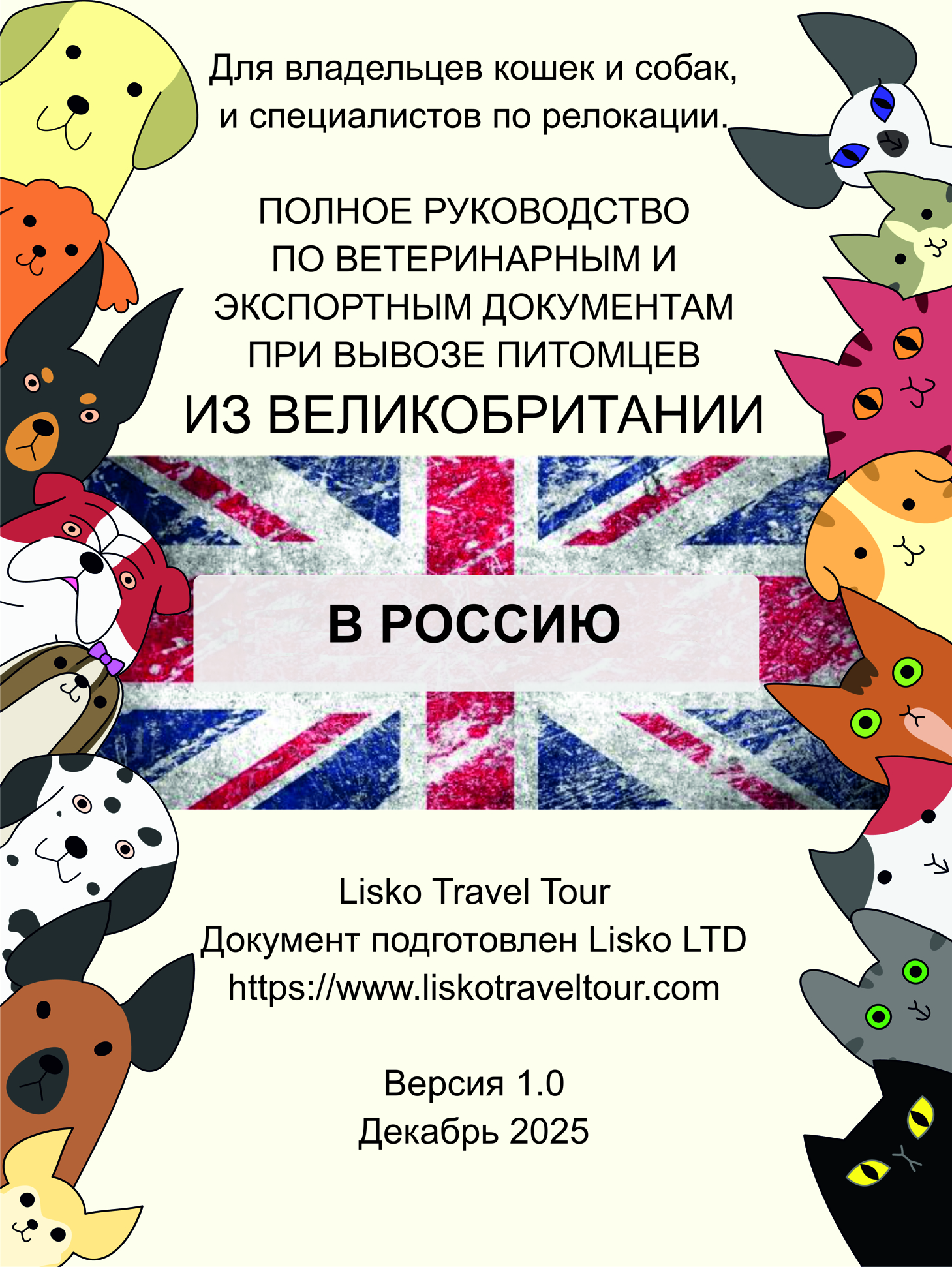
The Complete Expert Guide:
From the UK to Russia
Russian-language professional guide.
Профессиональный пошаговый гайд на русском языке.
This professional, step-by-step guide explains the full process of preparing and traveling with a pet from the United Kingdom to Russia.
It covers veterinary requirements, mandatory vaccinations, documents, airline rules, transit procedures, and arrival regulations — clearly, calmly, and without unnecessary bureaucracy.
The guide is based on real-life experience, practical cases, and current Russian regulations, designed to help pet owners and relocation specialists avoid mistakes and travel with confidence.
The guide consists of 34
pages
of detailed, practical guidance.
💷 Price
The full guide is available for = £45.
🖱️ To start the purchase, simply click on the guide’s cover image above.
📘 What’s Inside:
-
PART 1 — INTRODUCTION
Who this guide is for • Realistic travel routes from the UK to Russia • Key limitations and expectations -
PART 2 — VETERINARY REQUIREMENTS FOR RUSSIA
Microchip • Rabies vaccination rules • Mandatory additional vaccinations (from 2024) • Parasite treatments • Clinical examination • Veterinary health documents -
PART 3 — DOCUMENT SCENARIOS
EU pet passport • UK-only vaccination records • Russian passport • When health certificates are required • Common document pitfalls -
PART 4 — PET TRANSPORT OPTIONS
Passenger flights only • Why Heathrow is the only departure airport • Two-leg routes via Turkey, Serbia, Armenia, or Azerbaijan • Why cargo transport is risky -
PART 5 — FULL JOURNEY: UK → TRANSIT COUNTRY → MOSCOW
Airline booking rules • Adding a pet to the booking • Check-in and document control • Transit specifics • Pet handling during long connections -
PART 6 — TRANSIT RULES AND IMPORTANT WARNINGS
Why onward tickets are mandatory • Transit through Turkey • Rabies titre test risks • What happens if rules are misunderstood -
PART 7 — ARRIVAL IN RUSSIA
Veterinary control in practice • Green corridor rules • Limits on number of pets • When Rosselkhoznadzor permission is required -
PART 8 — COMMON MISTAKES
Missing additional vaccinations • Incorrect rabies validity assumptions • Transit misunderstandings • Documentation errors that cause refusals -
PART 9 — FINAL NOTES FROM THE AUTHOR
Calm conclusions • Practical advice • How to travel without stress — for you and your pet
📖 Language
This guide is provided in Russian language.
This guide helps you move step by step — clearly, calmly, and with confidence at every stage of your journey.
 Loading More Items