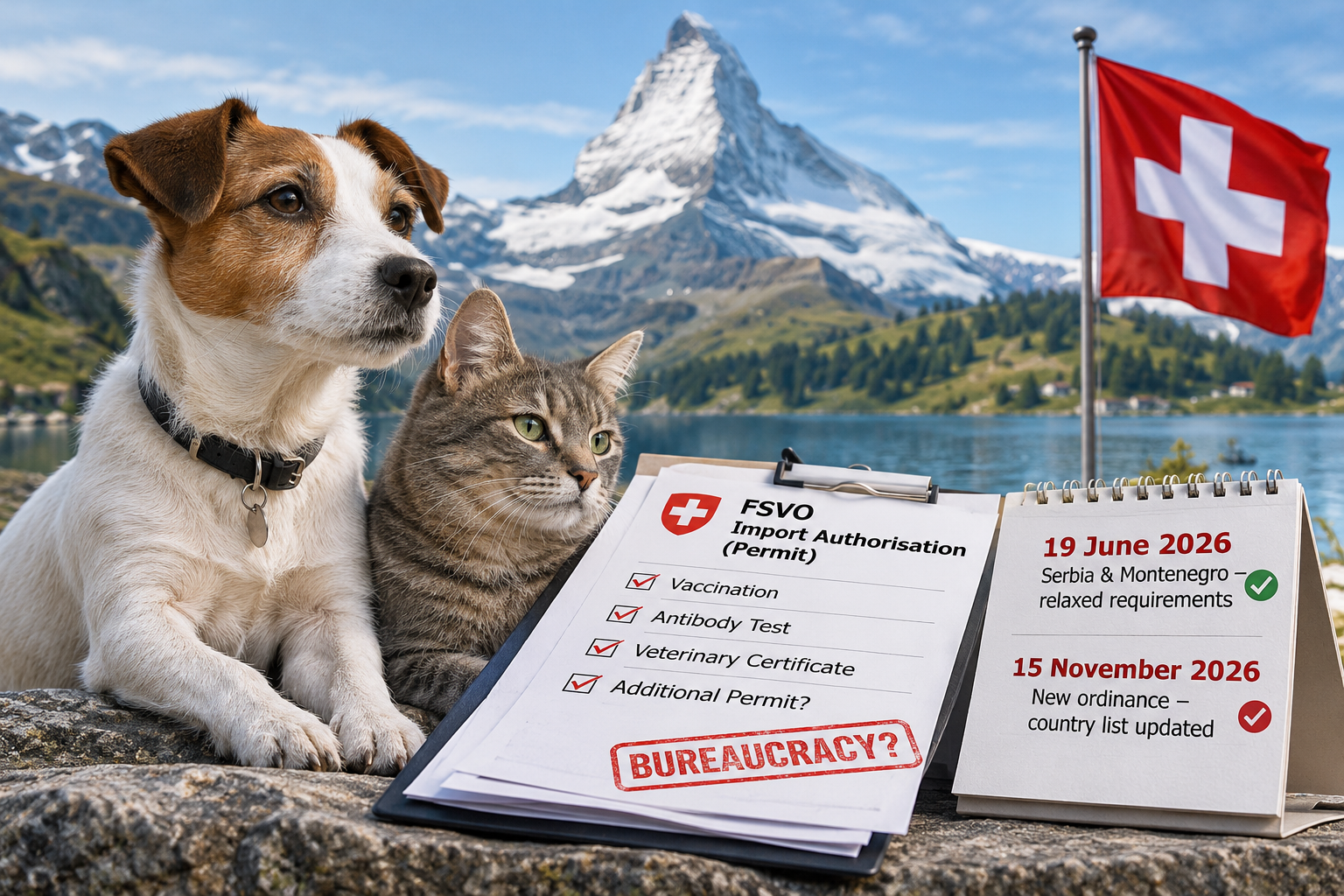
Switzerland's Pet Travel Rules 2026: When Animal Protection Becomes Bureaucracy
Switzerland is introducing revised pet travel regulations from 15 November 2026, but questions remain about permit requirements, overlapping implementation dates and the burden placed on pet owners. We examine the legislation and ask whether the syst
Norway's Pet Travel Rules 2026: EU Legislation and Unclear National Requirements
Norway's adoption of new EU pet travel legislation has raised questions about national requirements, implementation dates and legal clarity. What rules must pet owners follow when travelling with dogs and cats to Norway in 2026?
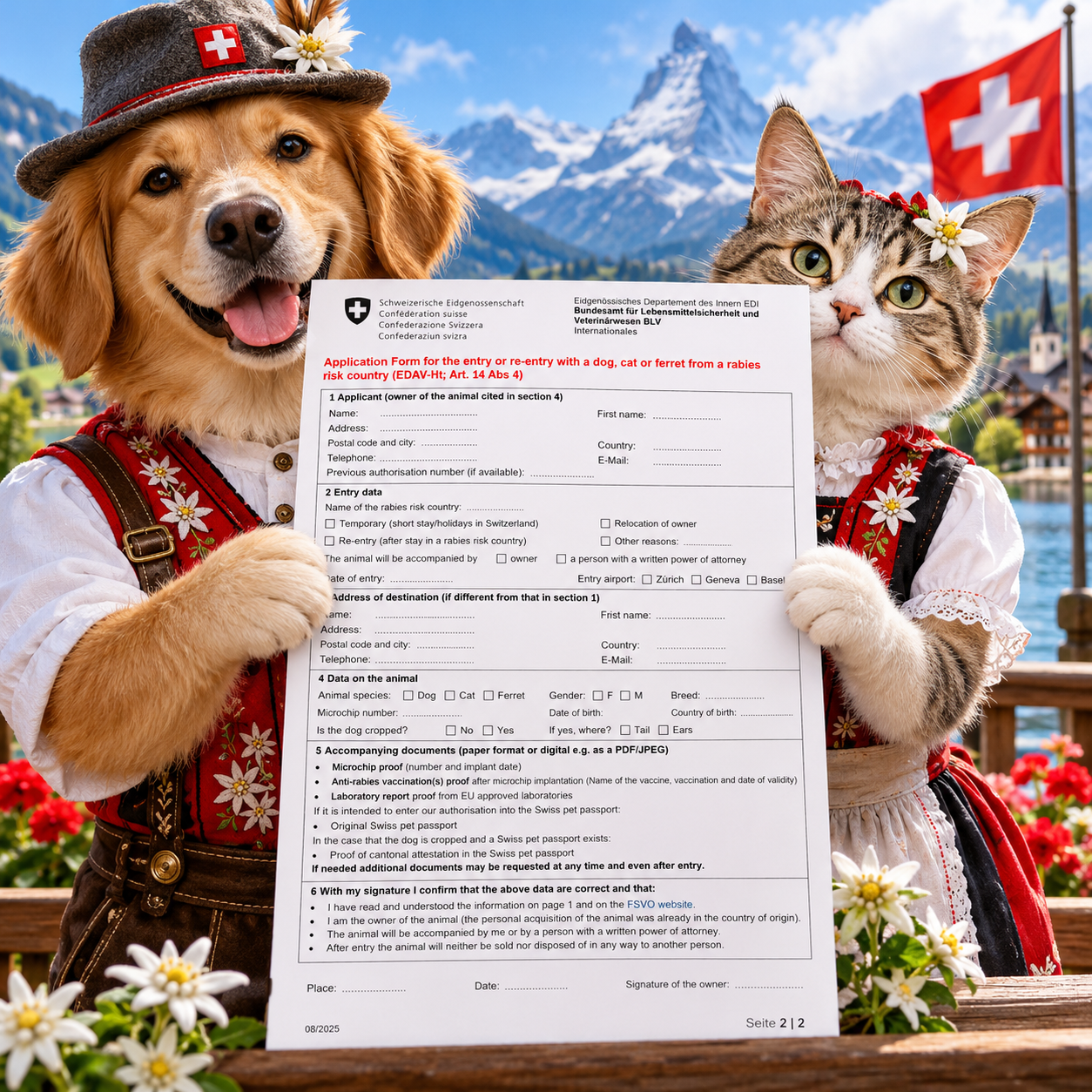
Switzerland Pet Travel Rules 2026: FSVO Import Authorisation and Rabies Changes
Switzerland is updating its pet travel rules from 15 November 2026. Find out when an FSVO import authorisation is required, how to apply, the rabies titre test requirements, and what changes for dogs and cats travelling from Serbia and Montenegro.

From St Petersburg to Dubai with K9 JETS: A Bernese Mountain Dog's Extraordinary Journey
The extraordinary journey of Rudiger, a Bernese Mountain Dog travelling from St Petersburg to Dubai via Europe and London. Discover the challenges of veterinary paperwork, the urgent UK export health certificate, an unforgettable K9 JETS private flig
Из Санкт-Петербурга в Дубай с K9 JETS: путешествие Рюдигера
История путешествия бернского зенненхунда Рюдигера из Санкт-Петербурга в Дубай через Европу и Лондон. Ветеринарные документы, срочное оформление британского сертификата 3926EHC, перелёт с K9 JETS и удивительное гостеприимство Jetex Dubai.
 Loading More Items

Switzerland's Pet Travel Rules 2026: When Animal Protection Becomes Bureaucracy
Information checked and updated: 5 November 2026
Switzerland's Pet Travel Rules 2026: When Animal Protection Becomes Bureaucracy
New regulations, additional permits and questions about when the rules actually apply
Switzerland has a reputation for precision, efficiency and respect for the law. Yet its arrangements for travelling with pets raise an uncomfortable question: at what point does protecting animal health become an unnecessarily complicated administrative exercise?
On 14 October 2026, the Swiss Federal Council adopted amendments to the Ordinance on the Import, Transit and Export of Pet Animals (EDAV-Ht). The amendments are due to enter into force on 15 November 2026.
According to the Federal Council, the changes are intended to improve the structure and readability of the legislation while aligning Swiss requirements with revised EU rules.
That sounds sensible. But a closer examination of the official documents reveals a system in which owners may still need to navigate several layers of veterinary rules, national permits and border procedures before travelling with an otherwise properly prepared animal.
Nobody is questioning the need to prevent rabies. The question is whether every additional administrative requirement is necessary, proportionate and clearly explained.
Serbia and Montenegro: why do the dates need explaining?
One particularly interesting issue concerns Serbia and Montenegro.
On 12 June 2026, the Swiss Federal Food Safety and Veterinary Office (FSVO) announced that, from 19 June, the rules applicable to countries with a favourable rabies situation would also apply to Serbia and Montenegro. The announcement stated that rabies antibody titration and the FSVO import permit would no longer be required for the relevant movements.
Yet the amendments adopted by the Federal Council on 14 October also include Serbia and Montenegro in the list of countries with a favourable rabies situation, with the amended ordinance entering into force on 15 November.
This does not necessarily mean that the two measures contradict each other. The June administrative position may have had a separate legal basis, with the November amendment subsequently updating the text of the ordinance.
But that distinction is precisely what should be explained to the public.
19 June 2026: FSVO announces the application of favourable-rabies-country requirements to Serbia and Montenegro.
15 November 2026: the revised national ordinance, including amendments to the country list, enters into force.
For somebody travelling with a dog or cat, the important question is not how the authorities organise their legislative amendments. It is what documents are required on the actual day of travel.
If different official documents refer to different dates, the authorities should explain the legal relationship between them rather than leave travellers to work it out themselves.
An additional import permit: what does it actually achieve?
Switzerland requires an FSVO import authorisation for certain direct flights carrying dogs, cats or ferrets from countries classified as presenting a high risk of rabies.
The animal must already satisfy the applicable veterinary requirements, including identification, valid rabies vaccination, an approved antibody titre test and the required waiting period.
The owner may also need an official veterinary certificate from the country of departure.
Nevertheless, for the relevant direct air arrivals, a separate application for import authorisation is required.
It is reasonable to ask what additional protection this administrative approval provides once compliance with the underlying veterinary conditions has already been established.
Advance examination of documents may help identify problems before an animal boards an aircraft. That is a legitimate potential benefit.
But if the purpose is advance verification, the authorities should explain why a separate permit is required for these particular journeys, how the procedure improves disease prevention and whether the same outcome could be achieved through a simpler system.
An additional authorisation is not automatically an additional safeguard. Its value depends on what it actually verifies and what risk it prevents.
The route can change the paperwork
Another complication is the distinction between direct entry by air from a rabies-risk country and entry after travelling through another European country.
The Swiss rules specifically require FSVO authorisation for certain direct flights. A journey through the European Union may involve a different combination of veterinary checks and supporting documents.
There can be sound reasons for different procedures at different entry points. Border control arrangements, document checks and the legal status of the preceding movement may all be relevant.
But the authorities should be able to explain why one route requires an additional authorisation while another may not.
Owners do not choose their route solely according to legislation. They consider flight availability, connections, their animal's welfare, the length of the journey and the cost.
Where the route changes the administrative obligations, those differences need to be explained in ordinary language, with practical examples.
What the November amendments actually change
The revised ordinance is not simply another set of import restrictions. It contains several provisions intended to align Swiss documentation with the updated European system.
Updated requirements for veterinary certificates and declarations based on EU Implementing Regulation 2026/705.
Revised provisions concerning authorised persons accompanying animals.
A general limit of five dogs, cats or ferrets under the non-commercial pet movement rules, subject to specified exceptions.
Updated rules for recording and issuing Swiss pet identification documents.
Clarification of rabies antibody testing and the 90-day waiting period for relevant third-country movements.
Transitional provisions allowing documents to continue being issued under the previous system until 31 December 2027.
The transitional arrangements are welcome. Documents issued before 1 January 2028 under the relevant provisions remain valid for the lifetime of the animal.
However, the existence of a transition period does not remove the need to explain which new forms apply to animals entering Switzerland from different countries and on different dates.
A reform intended to improve the readability of legislation should also improve the practical instructions supplied to the people who must comply with it.
Animal welfare must remain the priority
Veterinary controls exist for an important reason. Rabies is a serious disease and preventing its introduction is a legitimate public and animal health objective.
Microchipping, vaccination, antibody testing and appropriate waiting periods all serve identifiable purposes within the disease prevention system.
Administrative procedures deserve the same scrutiny.
Every requirement introduces the possibility of delay, misunderstanding or error. When a mistake affects an international journey, the animal may spend additional time in a transport environment while the owner attempts to resolve the problem.
A poorly explained requirement can therefore have consequences beyond paperwork.
The fact that a government has the legal authority to require a permit does not, by itself, answer whether the process is proportionate or whether it has been designed around the welfare of the animals concerned.
Good regulation should make safe travel easier to understand, not force owners to navigate unnecessary uncertainty.
What the Swiss authorities should explain
There are several questions that deserve clear answers from the Federal Food Safety and Veterinary Office.
How does that earlier decision relate to the amendments entering into force on 15 November 2026?
What additional veterinary protection is provided by an FSVO import authorisation where the animal already satisfies the relevant disease prevention requirements?
Why does the administrative procedure differ between direct air arrivals and certain journeys through the European Union?
Could a single official guidance document explain all applicable requirements, exemptions and effective dates for each type of journey?
These questions are not an objection to animal health protection. They are a request for greater transparency and accountability in the way the rules are applied.
Switzerland has every right to maintain effective controls on animals entering its territory. But the public has an equally legitimate interest in understanding why those controls are necessary and how they operate.
The responsibility for making the rules understandable should rest primarily with the authorities who create and administer them, not with individual pet owners trying to interpret several legal instruments before a journey.
Travelling to Switzerland with a pet?
For anyone planning to enter Switzerland with a dog or cat, the most important practical advice is to check the requirements for the actual route and date of travel.
Do not assume that requirements for entry from the European Union automatically apply to direct flights from a third country. Equally, do not assume that an import authorisation is necessary for every journey.
At LISKO TRAVEL TOUR, we help owners understand the veterinary requirements for international pet travel, examine their existing documents and identify issues that may need to be corrected before departure.
Our Pre-Travel Consultation can help you assess the route, relevant regulations, preparation schedule and documents required.
Already have your documents?
Our Pet Travel Document Check can identify missing information, inconsistencies or potential problems before airline check-in or border control.
Book a consultation or veterinary document check
Read pet travel legislation and country requirements
Official Swiss legislation and government sources
Federal Food Safety and Veterinary Office — Travelling with dogs, cats and ferrets
Official Swiss entry requirements, certificates, permits and veterinary guidance.
Swiss Federal Council — Ordinance amendments of 14 October 2026
Official publication notice and text of the amendments entering into force on 15 November 2026.
FSVO — Pet entry check and Serbia/Montenegro announcement
Official entry-check information, including the announcement dated 12 June 2026 concerning the application of favourable-rabies-country rules from 19 June.
FSVO — Preparing to travel with pets
Government guidance on applicable veterinary procedures and advance preparation.
Federal Office for Customs and Border Security — Dogs, cats and domestic animals
Official customs information and border requirements.
LISKO TRAVEL TOUR
International pet transport, professional travel planning and veterinary document checking.
WhatsApp:
+44 7734 760360
Consultations and document checks:
Order service
Pet travel legislation:
Country requirements