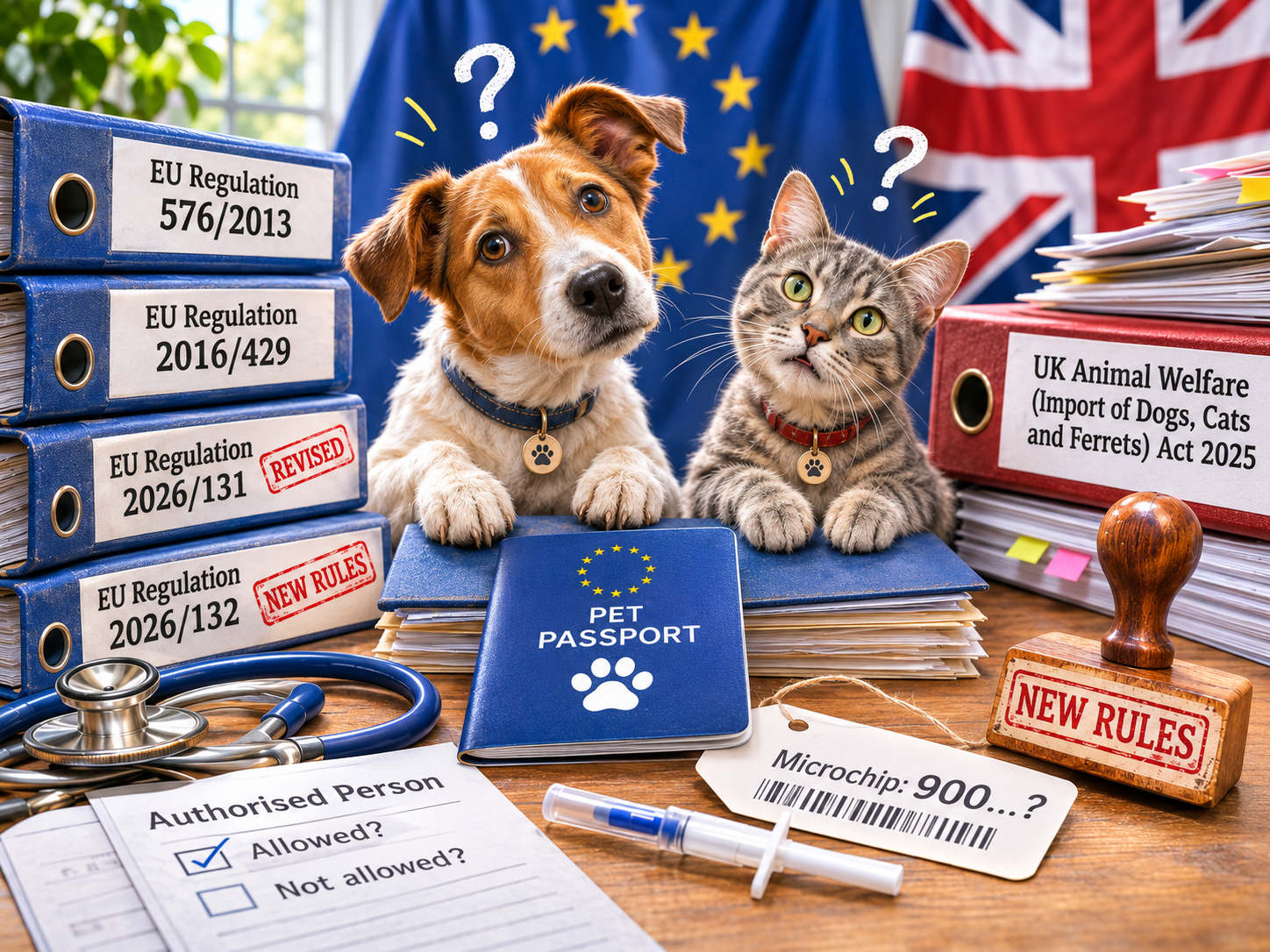
New EU and UK Pet Travel Rules: 13 Years of Mistakes, Microchip 900 and Another Legal Trap
After 13 years of disputes over authorised pet travel, the EU and UK are introducing new microchip identification rules for 2028. Why could microchip 900, conflicting government guidance and unresolved legal questions create even more problems for do
Новые правила ЕС и Великобритании: микрочипы 900, 13 лет ошибок и очередной закон с подвохом
За 13 лет власти так и не устранили споры вокруг перевозки животных уполномоченными лицами, но уже вводят новые требования к микрочипам с 2028 года. Почему законодательные ошибки и противоречивые инструкции ЕС и Великобритании могут обернуться серьёз

Switzerland's Pet Travel Rules 2026: When Animal Protection Becomes Bureaucracy
Switzerland is introducing revised pet travel regulations from 15 November 2026, but questions remain about permit requirements, overlapping implementation dates and the burden placed on pet owners. We examine the legislation and ask whether the syst

Norway's Pet Travel Rules 2026: EU Legislation and Unclear National Requirements
Norway's adoption of new EU pet travel legislation has raised questions about national requirements, implementation dates and legal clarity. What rules must pet owners follow when travelling with dogs and cats to Norway in 2026?
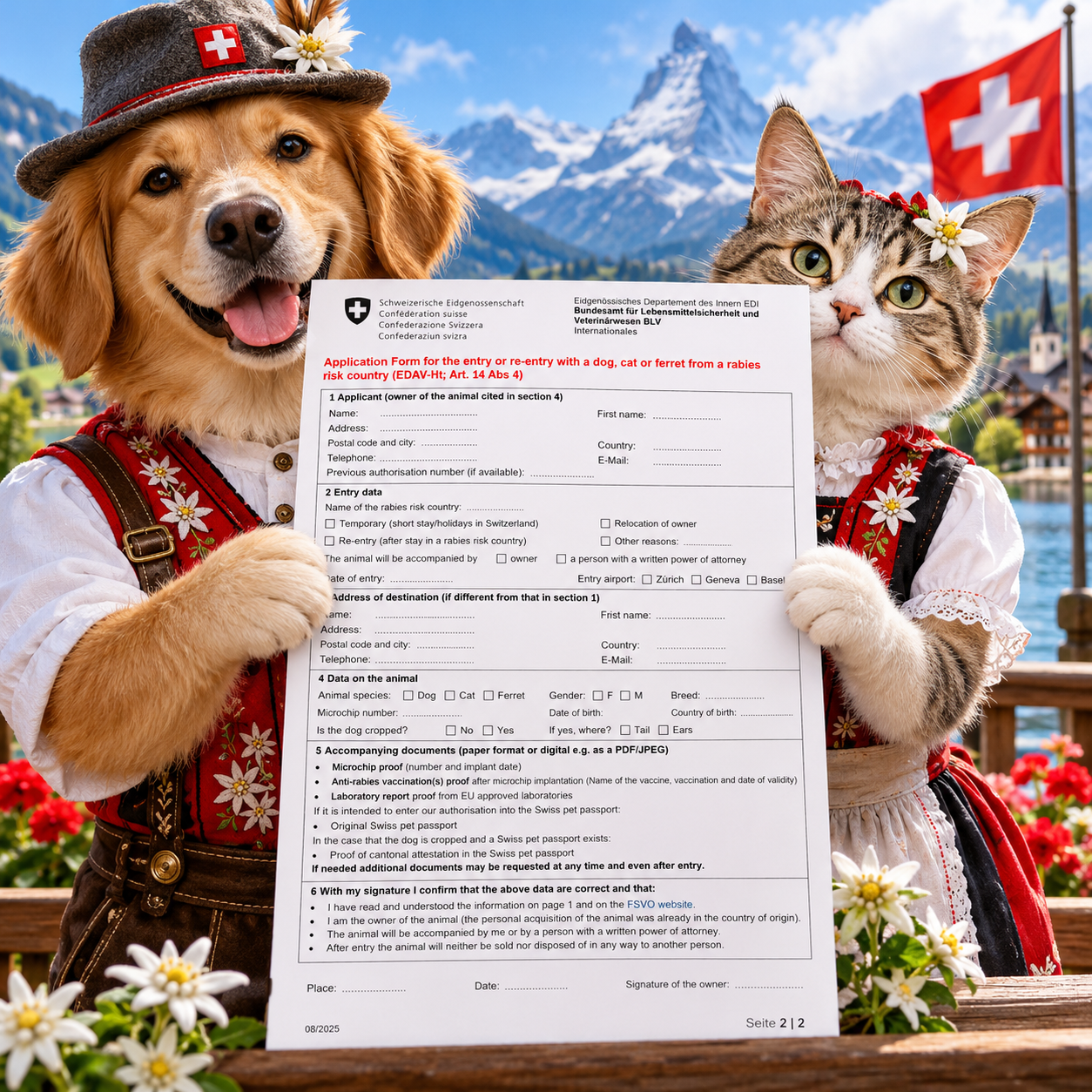
Switzerland Pet Travel Rules 2026: FSVO Import Authorisation and Rabies Changes
Switzerland is updating its pet travel rules from 15 November 2026. Find out when an FSVO import authorisation is required, how to apply, the rabies titre test requirements, and what changes for dogs and cats travelling from Serbia and Montenegro.
 Loading More Items

New EU and UK Pet Travel Rules: 13 Years of Mistakes, Microchip 900 and Another Legal Trap
LISKO Travel Tour Legal Analysis | 23 November 2026
New EU and UK Pet Travel Rules:
13 Years of Mistakes, Microchip 900 and Another Law with a Hidden Catch
Why new microchip requirements, authorised pet travel rules and conflicting veterinary guidance could create even more problems for dogs, cats and their owners
There is a remarkable habit in bureaucracy: when an official makes a mistake, admitting it is not always their first instinct. Sometimes it is far easier to write a new rule that makes the previous decision appear correct.
If that requires changing the law, so much the better. The whole exercise can then be proudly presented as an improvement to legislation.
And if travelling with pets becomes even more complicated, that can always be explained as a measure designed to protect their safety.
Foolishness does not begin when someone makes a mistake. It begins when, instead of admitting it, they rewrite the rules to prove they were right all along.
This is precisely the habit worth remembering when examining the latest changes to international pet travel legislation.
Regulation (EU) No 576/2013 was adopted in June 2013 and applied from December 2014 until April 2026.
During that period, its provisions concerning authorised persons accompanying animals repeatedly raised questions and disputes about how the rules should be applied.
And now, rather than first examining those disputed decisions, their causes and their consequences, lawmakers have produced another legal framework.
New requirements for authorised persons. New identification rules. New microchip country codes. New deadlines. New exceptions to existing exceptions.
Another legislative pie has come out of the oven. All that remains is to discover how many stones have been baked into it.
EU Regulation 576/2013: Thirteen Years of Legal Confusion over Authorised Pet Travel
Let us begin with a simple question.
Can the owner of a dog or cat authorise another person to transport their pet?
Article 3(d) of Regulation (EU) No 576/2013 expressly recognised an authorised person as an individual who had written authorisation from the owner to carry out the non-commercial movement of an animal on their behalf.
Furthermore, recital 10 of that Regulation expressly acknowledged that a pet might not always be travelling immediately alongside its owner or the authorised person.
Under the relevant documented circumstances, the legislation permitted a difference of up to five days between the movement of the animal and that of the owner or authorised person.
But the most interesting detail appeared in the official declaration.
Annex IV, Part 3, of Commission Implementing Regulation (EU) No 577/2013 provided for an animal to be accompanied either by its owner or by a person authorised in writing by the owner.
The five-day period in that declaration was linked to the movement of the person specified.
In other words, the concept of an authorised person was not included simply for decoration. The legislation genuinely provided for another individual to accompany an animal on the owner's behalf.
One might reasonably wonder what there was to misunderstand.
But consider an ordinary cat.
Its owner already lives in London. The cat is still in another country. The owner appoints an authorised person to bring the animal home.
The accompanying person has written authorisation. The veterinary documents are correct. The microchip works perfectly.
And suddenly somebody asks: when did the owner travel?
The owner has not travelled anywhere. They live in London and are waiting for their cat.
Perhaps they should have left the country first, simply to make a ceremonial return alongside their own pet?
That would probably have been the most convenient solution for the bureaucracy.
A pointless ticket. A pointless journey. Additional expenses.
But at least there would be proof of travel.
And this raises a question that deserves a proper answer: why could an authority require proof of the owner's own journey when the animal was accompanied by an authorised person?
Official UK Pet Travel Documents Also Recognised the Movement of an Authorised Person
There is a particularly interesting piece of evidence here.
The British official PETS08 form, in its June 2023 version, used when dealing with non-compliance with pet travel requirements, expressly referred to movement within five days of the owner or authorised person.
Similar provisions also appeared in the British veterinary certificate used for the non-commercial entry of animals.
This creates a rather interesting situation.
If official government documents recognised this alternative, then any decision requiring proof exclusively of the owner's journey deserves its own legal justification.
This does not, by itself, prove that every decision made by British border authorities was unlawful. Such a conclusion would require examination of individual cases and the legislation applicable at the time.
But the wording of the official form provides entirely legitimate grounds for demanding an explanation.
If the state itself provided for one procedure, why should a pet owner suffer because a different one may have been applied?
UK Animal Welfare Act 2025: When a Disputed Practice Becomes a New Legal Requirement
Now let us open the Animal Welfare (Import of Dogs, Cats and Ferrets) Act 2025.
The Act received Royal Assent on 2 December 2025.
Section 7 expressly provides for changes to the previous European declaration.
In particular, it provides for the removal of wording that allowed reference to the journey of an authorised person.
It also replaces the words "his movement" with "the owner's movement".
In other words, the relevant journey must now be that of the owner.
Section 5 provides for a new Article 5A, under which the relevant non-commercial entry of an animal accompanied by someone other than its owner requires evidence of the owner's own entry into Great Britain within the specified five-day period.
Exceptions for particular circumstances are provided for.
Importantly, as at 23 November 2026, the relevant sections of this Act have not yet come into force.
If the previous document already required proof exclusively of the owner's travel, why did Parliament need to remove the reference to the authorised person's movement?
Of course, lawmakers are entitled to change the rules for the future.
But a new law cannot automatically justify every decision made under the previous rules.
And here we return to that familiar bureaucratic habit.
Admitting a possible mistake is uncomfortable. Investigating its consequences is expensive. Accepting responsibility is even more difficult.
Changing the wording, however, is relatively easy.
Afterwards, everyone can announce that the position is now perfectly clear.
But yesterday's mistake does not become yesterday's lawful action simply because the legislation has been rewritten today.
To assess earlier decisions, the relevant law is the law in force when those decisions were made, not a version adopted afterwards.
What Changed in EU Pet Travel Rules from 22 April 2026?
The new European legal framework has also changed the position.
Article 245(2) of Regulation (EU) 2016/429 now links the movement of a pet by an authorised person to the movement of its owner within five days.
Commission Delegated Regulation (EU) 2026/131, applicable from 22 April 2026, establishes additional requirements, including written authorisation from the owner.
The new legal arrangement is stricter.
But two entirely different questions must not be confused.
First: can lawmakers change the rules governing the movement of animals accompanied by authorised persons? Yes, provided the applicable legal procedures are followed.
Second: does that mean every earlier requirement imposed by enforcement authorities was lawful? No.
Answering the second question requires examination of the previous legislation, official guidance and the decisions made in individual cases.
Yet instead of a public examination of those matters, we are presented with another set of rules.
And once again, pet owners are expected to adapt.
Pets Detained at the UK Border: Who Is Responsible When the Law Is Misinterpreted?
This is where the jokes end.
Article 35 of the former Regulation (EU) No 576/2013 provided for measures concerning animals found not to comply with the conditions for entry.
Those measures included returning the animal to its country of dispatch, placing it in isolation under official control and, as a last resort, euthanasia where return was not possible and isolation was not practicable.
This did not authorise the arbitrary destruction of animals.
But that is precisely why a correct determination of non-compliance is so important.
If an official incorrectly applies a requirement, the cost of that error may be far greater than an ordinary administrative inconvenience.
A flight can be rebooked.
A document can sometimes be issued again.
But if an animal has been seized, transferred to another person or has died, no revised instruction can undo what happened.
The new British legislation of 2025 contains another provision deserving particular attention.
Sections 1(6) and 1(7) provide for the possibility of further regulations concerning detained animals, including the transfer of ownership in specified circumstances.
This provision does not, by itself, prove that animals have been unlawfully seized or sold through rescue organisations.
However, any power to determine the fate of someone else's animal requires especially rigorous oversight.
How many animals have been detained because the owner could not provide evidence of their own journey?
How many of those decisions were challenged by owners?
How many animals were returned?
How many were transferred to quarantine facilities or animal rescue organisations?
What documents establish the legality of subsequent transfers of animals to other individuals or organisations?
How many animals were euthanised, and what were the specific legal and veterinary grounds for those decisions?
It would be wrong to claim, without evidence, that thousands of animals were unlawfully seized or resold.
But requesting official statistics, verifiable decisions and transparency is both reasonable and necessary.
A state entrusted with decisions about the fate of living creatures should not hide behind vague wording and the absence of public accountability.
New EU Pet Microchip Rules for 2028: Why Microchip 900 Raises More Questions
While owners are still trying to understand the rules governing authorised persons, European lawmakers have prepared their next surprise.
Regulation (EU) 2026/132 provides that, from 1 January 2028, relevant newly implanted microchips must contain the country code of the animal's original identification.
For example, 250 indicates France, 276 Germany and 826 the United Kingdom.
But millions of existing animals have microchips using manufacturer codes.
One such prefix is 900.
A microchip number beginning with 900 does not tell anyone where the animal was born, where it was first microchipped or which country it currently lives in.
Yet the microchip may be perfectly functional, unique and compliant with the relevant international technical standards.
Now let us see how the new rules could operate during an ordinary international relocation.
Russia, France and Germany: How a Legally Imported Dog Can Become a Legal Puzzle
Imagine a dog that was microchipped in Russia in 2029 with a number beginning with 900.
Its owner moves to France.
Article 13 of Regulation (EU) 2026/131 governs non-commercial entry from third countries and does not establish an obligatory country-of-identification code within the microchip number.
The dog enters France lawfully, provided all other applicable conditions are met.
Six months later, the owner moves to Germany.
Now Article 7 of the same Regulation applies, because the movement takes place between two EU Member States.
That provision refers to the country-code identification requirement and includes a transitional exception for microchips implanted before 1 January 2028.
But our dog's Russian microchip was implanted in 2029.
A rather interesting situation arises.
The dog was legally admitted to France.
Its microchip works.
Its rabies vaccination is valid.
Yet when the owner moves to Germany, a new legal question arises about the identification requirements that apply.
This does not prove that the animal will necessarily be refused entry. However, the general arrangements for recognising such newer foreign microchips during subsequent movements between EU Member States are not explained with sufficient clarity in the published provisions.
The dog has not changed. Only the article of legislation that must be applied has changed.
And now, instead of an ordinary move, its owner may face an exercise in comparative European legal analysis.
How Will Border Officials Establish When a Microchip 900 Was Implanted?
There is another small but extremely important detail.
A microchip beginning with 900 does not, by itself, reveal the date of its original implantation.
One dog receives such a microchip in December 2027.
Another receives one in February 2029.
Both microchips can be read.
But the transitional provision in Article 7(2)(a) depends precisely on the implantation date.
How is that date supposed to be established if the original documents have been replaced and the current veterinary certificate contains only the date on which the microchip was last read?
Perhaps the records of the original veterinary practice will be required?
What if the practice has closed?
Perhaps a certificate from the microchip manufacturer?
But the manufacturer does not necessarily know when a particular microchip was implanted in a particular animal.
Perhaps, before long, every dog will need to travel with a separate archive documenting its entire biography.
Preferably in duplicate, with translations, stamps and proof that it really is the same dog it was yesterday.
This, of course, is satire.
But the absence of a single, obvious procedure for establishing the original implantation date in the principal provisions examined is a perfectly serious question.
UK Microchip Rules After 2028: One Reform, Different Implementation Dates
DEFRA has announced that microchips first implanted in the United Kingdom will need to contain the country code of the animal's original identification.
According to the general guidance published on 20 November 2026, Northern Ireland is scheduled to apply the requirement from 1 January 2028, while England, Scotland and Wales are expected to apply it after 1 March 2028.
However, separate guidance for the veterinary sector refers to 1 January 2028 without making the same territorial distinction equally clear.
So even at the preparation stage, the official guidance requires clarification and consistency.
And this illustrates the problem rather well.
If two official explanations from the same government department do not provide an equally clear answer about the starting date, how can absolute precision be demanded of pet owners and veterinary professionals?
Existing compliant microchips, meanwhile, do not automatically need replacing.
But the arrangements for foreign microchips implanted after the new requirements begin, particularly where an animal is permanently relocating, still require further clarification.
Who Should Pay for Mistakes in Government Pet Travel Regulations?
This brings us to the central question.
The owner is responsible for preparing their pet correctly.
The veterinarian is responsible for preparing the documents correctly.
The transport provider is responsible for following the required procedures.
But what happens when the mistake is in the government's own guidance?
Who is responsible when an official applies a requirement that has not yet come into force?
Who is responsible when an official form permits one procedure but the actual inspection demands another?
Who is responsible for an animal being detained because a legal provision has been misinterpreted?
It is particularly strange when, instead of answering these questions, the authorities produce another legislative amendment.
Anyone can make a mistake.
But mature government regulation is not measured by the ability to rewrite rules endlessly.
It is measured by the willingness to acknowledge mistakes, address their consequences and make sure they are not repeated.
Correcting a law does not mean correcting a mistake.
If a government authority incorrectly applied the previous rule, adopting a new one does not remove its responsibility to account for earlier decisions.
What Must the European Commission and DEFRA Explain Before the New Rules Take Effect?
Clear, publicly available and legally grounded answers are needed.
Why did the previous European declaration allow reference to the authorised person's journey, while the new British legislation specifically provides for removing that alternative?
Second.
What legal grounds were used in cases where an accompanying person was required to provide evidence exclusively of the owner's journey?
Third.
How will a microchip beginning with 900, lawfully implanted in a third country after 1 January 2028, be recognised during subsequent movements of the animal within the EU?
Fourth.
What documents must the owner provide to establish the original microchip implantation date?
Fifth.
How will the United Kingdom register and permit international travel for animals with foreign microchips that do not contain a country code?
Sixth.
What safeguards exist for independent review and appeal when animals are detained and ownership may subsequently be transferred?
These answers must be available before the new requirements cause difficulties at the border.
Not afterwards.
New Pet Travel Laws: Animal Welfare or Another Bureaucratic Experiment?
International veterinary rules are necessary.
Nobody is suggesting abandoning rabies vaccination, animal identification or veterinary evidence of an animal's health status.
But animal welfare and administrative convenience are not the same thing.
Regulations should protect animals against genuine risks, not create additional obstacles through legal provisions that have not been properly coordinated.
A dog does not know what Regulation 576/2013 is.
It has not read Regulation 2016/429.
And it certainly has no intention of studying Regulations 2026/131 and 2026/132.
It simply wants to be with its human.
If its owner moves, the dog goes with them.
If its owner arranges for someone else to bring it home, it travels with an authorised person.
And if its microchip works, its documents are valid and the veterinary requirements are met, it should not become the victim of another legislative puzzle.
Thirteen years after the adoption of the previous European Regulation, the law has changed, but the questions surrounding its interpretation and responsibility for mistakes have not disappeared.
Now another set of requirements is being prepared.
Perhaps some of them genuinely will improve the traceability of animals.
But new legislation should not become a convenient way to avoid discussing mistakes made under the old rules.
Because the most dangerous official is not necessarily the one who made a mistake.
Far more dangerous is the one prepared to change the rules for everyone else rather than ever admit to being wrong.
And before offering pet owners another freshly baked legislative pie, it might be wise to check the ingredients.
Because a stone hidden inside that pie could prove very expensive indeed.
Especially when the animal is the one that pays the price.
Pet Travel Document Checks and Professional International Pet Travel Consultations
At LISKO Travel Tour, we examine not only the official instructions published by veterinary authorities, but also the legislation itself, amendments, transitional provisions and effective dates.
We pay particular attention to complex routes involving third countries, the European Union and the United Kingdom.
Before travelling, it is important to establish exactly which rules apply to the individual animal, its microchip, veterinary documents, authorised person and intended route.
Book a Pre-Travel Consultation. We can assess your route, preparation schedule and the applicable veterinary requirements.
If your documents have already been prepared
Book a professional Pet Travel Document Check. We will examine their compliance with the requirements of the destination and transit countries.
Book a Pre-Travel Consultation or Pet Travel Document Check
International Pet Travel Rules and Veterinary Requirements by Country
Official EU Legislation, UK Acts and Government Sources
Regulation (EU) No 576/2013
Former non-commercial pet movement rules, including Articles 3 and 35 and recital 10.
Commission Implementing Regulation (EU) No 577/2013
Annex IV, Part 3. The previous declaration concerning an owner or authorised person.
APHA — Pet Travel Non-compliance Return PETS08
British form, June 2023 version, containing a reference to the owner or authorised person.
Animal Welfare (Import of Dogs, Cats and Ferrets) Act 2025
Sections 1, 5, 7 and 8. Proposed changes concerning authorised persons and powers relating to detained animals.
Regulation (EU) 2016/429
Article 245. The revised legal framework for non-commercial pet movements involving authorised persons.
Commission Delegated Regulation (EU) 2026/131
Articles 4, 7, 12 and 13. New provisions on accompanying persons, identification and international animal movements.
Commission Delegated Regulation (EU) 2026/132
New requirements for microchip identification numbers containing the country code from 1 January 2028.
DEFRA — Pet Animals: Preparing for Changes
Official guidance dated 20 November 2026 concerning forthcoming changes in the United Kingdom.
Editorial note: This article contains critical commentary on legislation and the potential consequences of its implementation. Examples of disputed decisions do not mean that the unlawfulness of individual detentions has already been established. Such findings require examination of the individual cases and the legislation in force at the time of the relevant decision.
LISKO TRAVEL TOUR
International pet transport, professional travel consultations and veterinary document checking.
WhatsApp:
+44 7734 760360
Consultations and document checks:
Book a Service
Veterinary rules by country:
International Pet Travel Requirements