
Tell the Truth and Pay £250: Brussels Has Reinvented Honesty
People often ask me whether their EU pet passport will still be accepted. The new Regulation offers two impressive words — “habitual residence” — but no clear test, standard evidence or workable border procedure. Tell the truth, and honesty may cost

When the Pride of the Nation Stoops to Cheap, Shameless Hypocrisy
British Airways calls pets members of the family and promises VIP treatment, yet refuses to let even the smallest pet remain beside the person they love and trust.

USA Pet Travel Update 2026: CDC Changes Approved Rabies Titre Laboratories
CDC updated its list of approved rabies serology laboratories for dogs entering the United States from high-risk dog-rabies countries. The transition period for removed laboratories ended on 12 July 2026. We explain which laboratories are affected, w
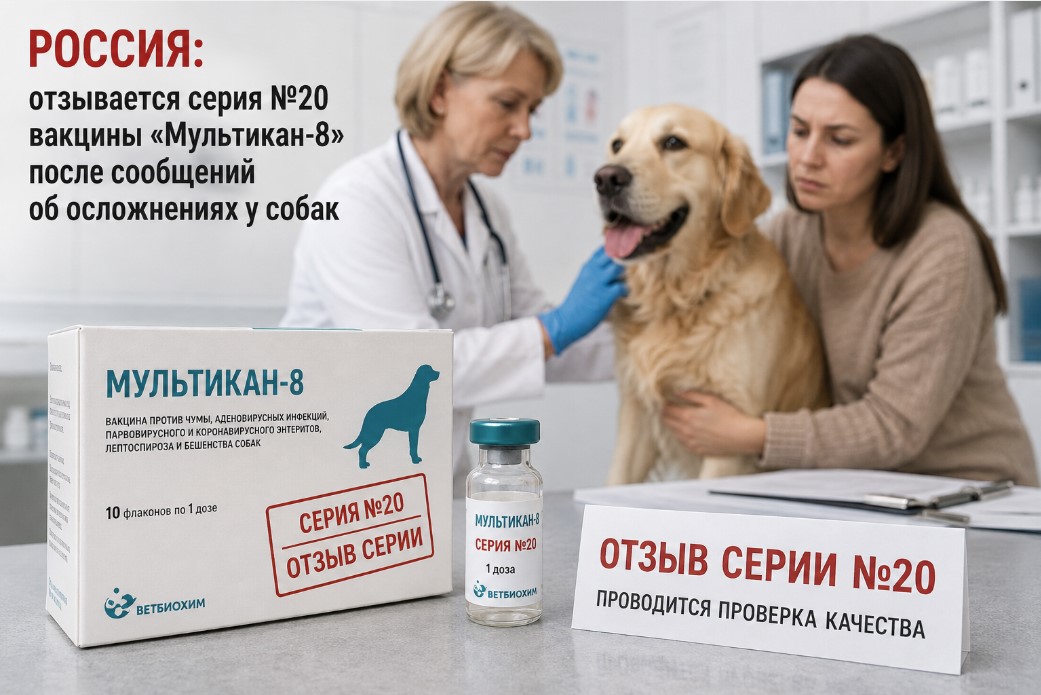
Россия: отзывается серия №20 вакцины «Мультикан-8» после сообщений об осложнениях у собак
В России отзывается серия №20 вакцины для собак «Мультикан-8». Проверка начата после сообщений о серьёзных осложнениях и случаях гибели собак. Причинная связь с вакциной пока официально не установлена.
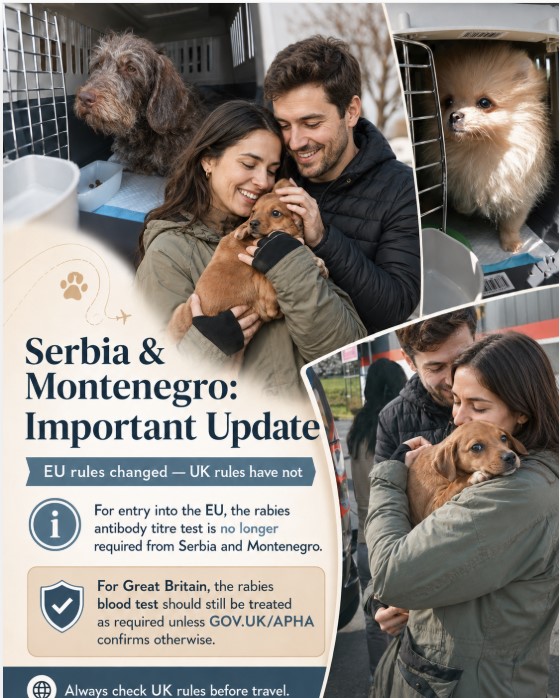
Serbia, Montenegro and pet travel to Great Britain: an important clarification
Serbia and Montenegro no longer require a rabies antibody titre test for pets entering the EU, but Great Britain has not confirmed the same change. For travel to the UK, the rabies blood test should still be treated as required unless GOV.UK or APHA
 Loading More Items
Tell the Truth and Pay £250: Brussels Has Reinvented Honesty
Tell the Truth and Pay £250:
Brussels Has Reinvented Honesty
A new EU pet passport rule, an undefined “habitual residence” test, and a remarkably efficient tax on honesty
People often ask me about pet travel rules because I specialise in the legislation governing the movement of animals across the EU, the United Kingdom and several other jurisdictions. Usually, I can open the relevant Regulation, find the applicable article and explain what must be done. It may be inconvenient, expensive or unnecessarily complicated, but at least there is normally a rule that can be read and followed.
This time, however, I find myself doing something rather less impressive for a supposed specialist: I open the Regulation, read it carefully, look for the missing explanation, read it again, and eventually spread my hands in the universal international gesture meaning, “Apparently, nobody knows.”
The new EU legislation says that an EU pet passport must have been issued in the Member State where the owner “habitually resides”.
These are two wonderfully dignified words. They sound as though they have arrived wearing a dark suit, carrying a leather briefcase and accompanied by three lawyers.
Unfortunately, the Regulation does not explain how many days make a person habitually resident, over what period those days should be counted, what documents prove the fact, who is supposed to investigate it, when the investigation should take place or what happens when somebody genuinely divides their life between several countries.
Apart from the meaning of the requirement and the method of applying it, everything is perfectly clear.
Where do you “usually” live?
A human passport will not solve the mystery because British and most European passports do not contain the holder’s residential address. Nationality proves nationality, not residence. A British citizen may live in France, a French citizen may live in London, and a Belgian may live mainly in airports while maintaining strong emotional ties to a suitcase somewhere near Terminal 2.
The pet passport may contain an address, but an address written in a pet passport is not a judicial determination of the owner’s centre of life. People move. People have several homes. People use correspondence addresses. Some people work in one country, sleep in another and spend enough time in a third to know which supermarket has the decent tomatoes.
So how is a border official expected to determine where the owner habitually resides? Will there be a short interview?
“Where do you live?”
“Mostly in London, but I have a home in France, work in Belgium and spend several months each year in Spain.”
“I see. And where is your favourite dressing gown?”
“France.”
“Where do you keep your good frying pan?”
“Spain.”
“Where is your tax adviser?”
“He is hiding.”
“Very suspicious. Please proceed to Secondary Inspection.”
Perhaps officials will be issued with a special Habitual Residence Detection Kit containing a crystal ball, a council tax bill and a small dog trained to locate the owner’s principal toothbrush.
The difficulty for me is that people expect a professional answer. They ask, “Vlad, will this EU pet passport be accepted?” I ought to be able to answer yes or no, explain the conditions and identify the required evidence. Instead, the honest answer is that the Regulation contains a requirement, but does not provide a workable mechanism for proving or consistently checking it.
The law has built a beautiful front door, fitted a very expensive lock and then thrown the key into the Channel.
Honesty now costs £250
The practical consequences are even more absurd because the system creates a financial incentive not to volunteer information. I will never advise anyone to lie to an official, but it is impossible to ignore what the rule actually encourages.
If nobody asks where the owner lives, the passport may be checked in the normal way. The microchip matches, the rabies vaccination is valid, the veterinary entries are correct, the animal is healthy and everyone continues the journey.
If the owner is asked and honestly says, “I live mainly in Britain,” the answer may suddenly become, “Thank you for your honesty. You now need an Animal Health Certificate. That will be £250.”
It is difficult to imagine a more efficient honesty tax.
“Stephen, are you an honest man?”
“Yes, sir. Absolutely.”
“Excellent news, Stephen. That will be £250.”
“Why?”
“Because you told us the truth.”
“What would have happened if I had said nothing?”
“Nothing at all.”
“So I am paying £250 for being honest?”
“No, no, sir. You are paying £250 for a certificate confirming that your perfectly identifiable, properly vaccinated and correctly documented animal remains exactly as safe as it was five minutes ago.”
“Does the certificate improve the vaccination?”
“Certainly not.”
“Does it change the microchip?”
“Of course not.”
“Does it protect anyone from rabies?”
“Please stop asking technical questions. You are holding up the queue.”
There is something genuinely unpleasant beneath the comedy. The person who openly explains a complicated living arrangement may be punished with another appointment, another certificate and another substantial bill, while a person in identical circumstances who is never asked may travel without difficulty.
That is not a functioning control system. It is a game played into one goal, with the honest traveller helpfully carrying the ball, blowing the whistle and paying for the stadium.
Is the virus interested in the owner’s residence?
It also has remarkably little to do with veterinary safety. Rabies does not inspect the owner’s council tax records. A microchip does not stop working when its owner spends too many nights in Britain. A valid vaccination does not become less effective because the person holding the lead lives on the wrong side of the Channel.
Real veterinary protection comes from identifying the animal, maintaining a valid rabies vaccination, carrying out antibody testing and waiting periods where required, completing parasite treatment and ensuring that veterinary records are accurate and authentic. Those requirements concern the animal, have an identifiable purpose and can actually be checked.
The habitual residence of the owner does none of those things. It may serve an administrative objective by limiting access to EU pet passports for people based outside the Union, but if that is the objective, the EU should say clearly how the restriction works. It should define the test, specify the evidence, identify the responsible authority and explain what happens when the owner moves.
Instead, we have been given two words and invited to build the rest of the legal system ourselves.
Twelve years of practice — and this is the improvement
This would be amusing if it were the first time. Unfortunately, Regulation (EU) No 576/2013 was adopted in 2013, and during the years in which it operated, pet owners and professional transporters repeatedly encountered conflicting interpretations. Recommendations mysteriously became legal obligations, requirements appeared that could not be found in the Regulation, and different officials confidently gave completely different answers to the same question.
For nearly twelve years, parts of the system struggled to apply rules that were at least capable of being checked on paper. Having considered this record, someone apparently decided that the obvious improvement was to add a requirement that cannot normally be checked at all.
One has to admire the confidence.
“Valid for the lifetime of the animal”
Then there is the old promise that an EU pet passport would remain valid for the lifetime of the animal, provided the health information and rabies vaccination remained current. Owners understood this in the ordinary human way: the passport would remain valid and they would be able to use it.
That interpretation was clearly far too unsophisticated.
The modern diplomatic explanation appears to be that the passport remains valid for life, although it may not necessarily be accepted for the journey for which a passport exists.
“But you said it would remain valid.”
“It does remain valid.”
“Can I use it?”
“That is a separate question.”
“If I cannot use it, in what sense is it valid?”
“In the regulatory sense.”
“What does that mean?”
“It means the passport remains valid right up until the moment you attempt to rely upon it.”
This is diplomacy at its finest. A promise is made, kept grammatically and emptied of practical meaning. It is rather like guaranteeing a kettle for life on the condition that nobody ever attempts to boil water in it.
The passport is still valid. It is merely resting.
What will actually happen at the border?
Meanwhile, a border official facing a queue of owners and animals cannot realistically investigate where every person has established the stable centre of their personal life. A proper assessment might require evidence about housing, work, family, financial interests, regularity of presence and the reasons for staying in different countries. Courts sometimes require pages of evidence to determine habitual residence, yet a ferry-terminal official is apparently expected to settle the question somewhere between scanning the microchip and asking whether the dog has been treated for tapeworm.
What will happen in reality is obvious. One official will ask, another will not. One country will demand evidence, another will wave the traveller through. One veterinarian will refuse to issue a passport, another will accept an address without further questions, and one exceptionally honest owner will discover that telling the full truth costs £250.
The questions the European Commission must answer
The European Commission therefore needs to answer some very ordinary questions. What exactly constitutes habitual residence for the purpose of a pet passport? What evidence proves it? At what moment is it assessed? Who verifies it? What happens when someone genuinely lives between countries? What happens after the owner moves? How does the rule apply to passports issued before 22 April 2026, and how can an owner challenge a refusal while standing at the border with an animal?
Until those answers exist, this is not effective control. It is legislative theatre, except the audience pays for the tickets and the dog has missed the ferry.
After all these years, Europe had an opportunity to make pet travel legislation clearer, more consistent and easier to apply. Instead, it created a condition that honest people may be charged for admitting, officials cannot reliably verify and animals cannot possibly understand.
Still, we should look on the bright side. The passport remains valid for life.
Now, Stephen, about that £250.
Specialist in pet movement legislation covering the European Union, the United Kingdom, the United States, the United Arab Emirates and 12 other jurisdictions
Official legal sources
Commission Delegated Regulation (EU) 2026/131
Commission Delegated Regulation (EU) 2026/132
LISKO TRAVEL TOUR
Professional pet travel planning, route assessment and veterinary document checking.
WhatsApp:
+44 7734 760360
Send a transport request:
Order transport
Check pet travel legislation:
Country requirements